Commercial building demolition is one of the most technically demanding and carefully regulated activities in the construction industry. In a densely developed region like Orange County, where aging structures stand adjacent to active businesses, busy roadways, and residential communities, the process requires meticulous planning, skilled crews, and a thorough understanding of local codes and environmental requirements. Whether a building is being taken down to make way for new development, removed because of structural compromise, or cleared for urban renewal, the demolition process is far more complex than it might appear from the outside.
This guide explores the methods, stages, and considerations that define Commercial Building Demolition Orange County, offering property owners, developers, and project planners a comprehensive overview of what the process involves.
Why Commercial Buildings Are Demolished
A commercial building may reach the end of its useful life for many reasons. Structural deterioration is one of the most common causes long-term exposure to seismic activity, moisture intrusion, or deferred maintenance can compromise a building’s integrity to the point where repair is no longer feasible or economically justified. Outdated mechanical, electrical, and plumbing systems that cannot be economically upgraded also drive demolition decisions.
Zoning changes and urban redevelopment initiatives frequently require the removal of existing structures to create space for new mixed-use developments, transit infrastructure, or community facilities. Buildings that contain hazardous materials such as asbestos, lead-based paint, or polychlorinated biphenyls may need to be demolished when the cost and complexity of remediation exceeds the building’s functional value. Code non-compliance is another significant factor structures that cannot be brought into conformance with current building codes, fire safety regulations, or accessibility requirements under the Americans with Disabilities Act may be candidates for demolition and rebuilding.
Types of Commercial Building Demolition
Commercial demolition is not a one-size-fits-all process. The method selected for any given project depends on the building’s size, construction type, location, proximity to neighboring structures, and the goals of the property owner or developer.
Mechanical Demolition
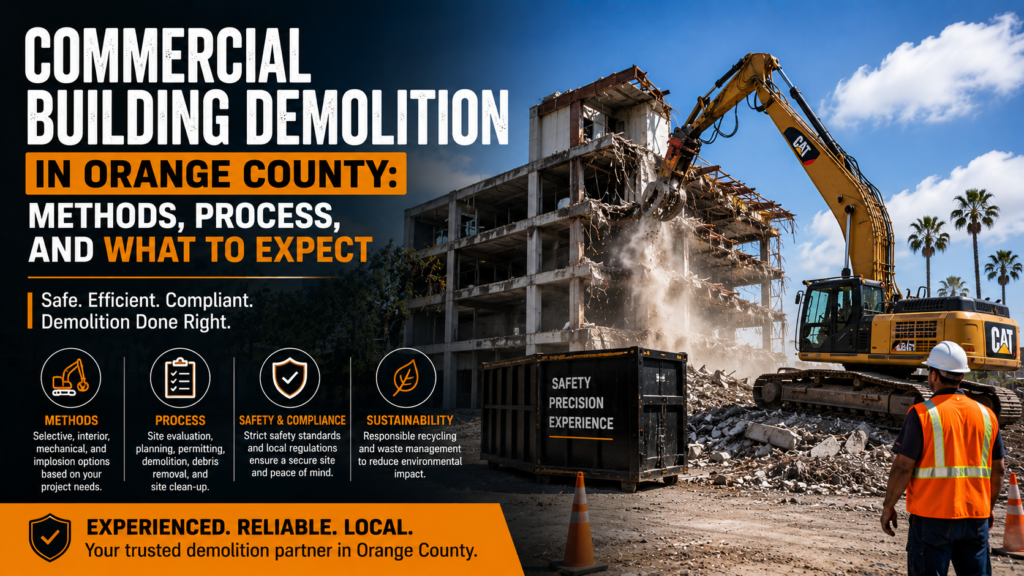
Mechanical demolition is the most commonly used method for mid-sized and large commercial structures. It relies on heavy equipment including excavators fitted with hydraulic shears, crushers, pulverizers, and hammers to systematically dismantle the structure. High-reach excavators are particularly well suited for multi-story buildings in Orange County’s urban and suburban environments. These machines can extend to considerable heights and work from the top of a structure downward, breaking materials into manageable pieces that are then removed by ground crews and haul trucks.
Mechanical demolition offers good control over the direction and pace of the teardown, generates less uncontrolled debris than explosive methods, and allows for the separation and recycling of materials during the process. It is also adaptable to confined urban sites where surrounding buildings must be protected.
Selective Demolition and Deconstruction
Selective demolition also referred to as strip-out demolition or deconstruction takes a more methodical approach. Instead of reducing the entire building to rubble as quickly as possible, selective demolition focuses on carefully removing and preserving valuable components for reuse or recycling. Steel beams, copper wiring, dimensional lumber, bricks, architectural elements, and mechanical equipment may all be salvaged during this process.
This approach is preferred on projects where sustainability goals are paramount. Up to 85 percent of a building’s materials can potentially be diverted from landfill through careful deconstruction. However, selective demolition is significantly more labor-intensive and time-consuming than mechanical methods, which makes it more appropriate when the value of recoverable materials justifies the additional effort and when project timelines allow for the slower pace.
Implosion
Implosion is the dramatic method most people associate with large building demolitions. It involves strategically placing explosive charges near the structural support elements of a building columns, load-bearing walls, and core shear walls and detonating them in a precisely timed sequence that causes the structure to collapse inward upon itself. Implosion is particularly effective for large concrete and steel-frame structures in open areas where the debris footprint can be controlled.
Despite its dramatic appearance, implosion represents only a small fraction well under one percent of all commercial demolitions. The extensive planning, engineering analysis, permitting, and public safety requirements associated with implosion make it practical only for specific large-scale projects. In densely developed Orange County, the proximity of neighboring buildings, utilities, and public spaces further limits the application of this method.
The Commercial Demolition Process: Step by Step
Regardless of the method used, commercial building demolition in Orange County follows a structured process governed by state and local regulations.
Pre-Demolition Survey and Assessment
Every commercial demolition project begins with a thorough structural and environmental survey. Engineers and certified inspectors evaluate the building’s construction materials, structural system, and load-bearing components. Critically, they assess the building for the presence of hazardous materials including asbestos-containing materials, lead-based paint, mercury-containing equipment, PCB-laden electrical components, and any other regulated substances that must be addressed before demolition can begin.
Hazardous Materials Abatement
If hazardous materials are identified, licensed abatement contractors must remove and properly dispose of them in full compliance with California Department of Toxic Substances Control (DTSC) requirements and the South Coast Air Quality Management District (SCAQMD) regulations. Asbestos abatement, in particular, is a highly regulated process that requires air monitoring, protective equipment, and documentation throughout. This phase must be fully completed before any structural demolition work begins.
Utility Disconnection
All utility services including gas, electricity, water, sewer, and telecommunications must be formally disconnected by the respective service providers before demolition equipment touches the building. Improperly managed utility disconnections can create serious hazards during demolition, including fire, electrocution, and gas explosions.
Permitting and Regulatory Compliance
Commercial demolition in Orange County requires demolition permits from the applicable city or county building department. Depending on the project, additional approvals may be required from the fire department, regional environmental agencies, and traffic management authorities if road closures or detours are needed. Contractors must also comply with OSHA 29 CFR 1926 Subpart T, which governs demolition safety standards for construction workers.
Structural Demolition
Once all preparatory steps are complete, structural demolition begins. Ground crews implement dust control measures, establish perimeter barriers, and set up traffic management systems if the work affects adjacent roadways. The demolition sequence is carefully planned to maintain the stability of the structure as sections are removed, preventing uncontrolled collapse that could endanger workers or neighboring properties.
Debris Removal and Recycling
Modern commercial demolition generates large volumes of materials that can be recycled rather than landfilled. Concrete is typically crushed and repurposed as road base aggregate. Ferrous and non-ferrous metals are sorted and sent to scrap processors. Clean wood framing may be chipped for mulch or reused in other construction applications. In California, construction and demolition debris diversion requirements under AB 341 and local jurisdictional ordinances encourage contractors to maximize recycling and document diversion rates.
Site Clearing and Restoration
After all structural materials have been removed, the site is graded, compacted, and cleared in preparation for its next use. If the site is being prepared for new construction, grading and soil compaction work may begin immediately, allowing the development cycle to move forward efficiently.
Safety Considerations in Urban Orange County Settings
Commercial demolition in Orange County presents unique safety challenges. The county’s dense mix of commercial corridors, retail centers, industrial parks, and residential neighborhoods means that demolition sites are rarely isolated from public activity. Experienced demolition contractors use a combination of physical barriers, enclosures, dust suppression systems, vibration monitoring, and noise mitigation to protect neighboring properties and the general public throughout the project.
Traffic management is also a significant concern. Many commercial demolition sites in Orange County are adjacent to major arterials and busy intersections, requiring coordination with city transportation departments to manage lane closures, detours, and truck routing.
Conclusion
Commercial building demolition in Orange County is a sophisticated, multi-phase process that demands expertise, regulatory compliance, and a commitment to safety and environmental responsibility. From the initial hazardous materials assessment through structural teardown and debris diversion, each phase of a commercial demolition project must be executed by qualified professionals who understand both the technical demands of the work and the regulatory landscape of Southern California. When done correctly, commercial demolition creates the clean slate that developers, property owners, and communities need to build a better future.